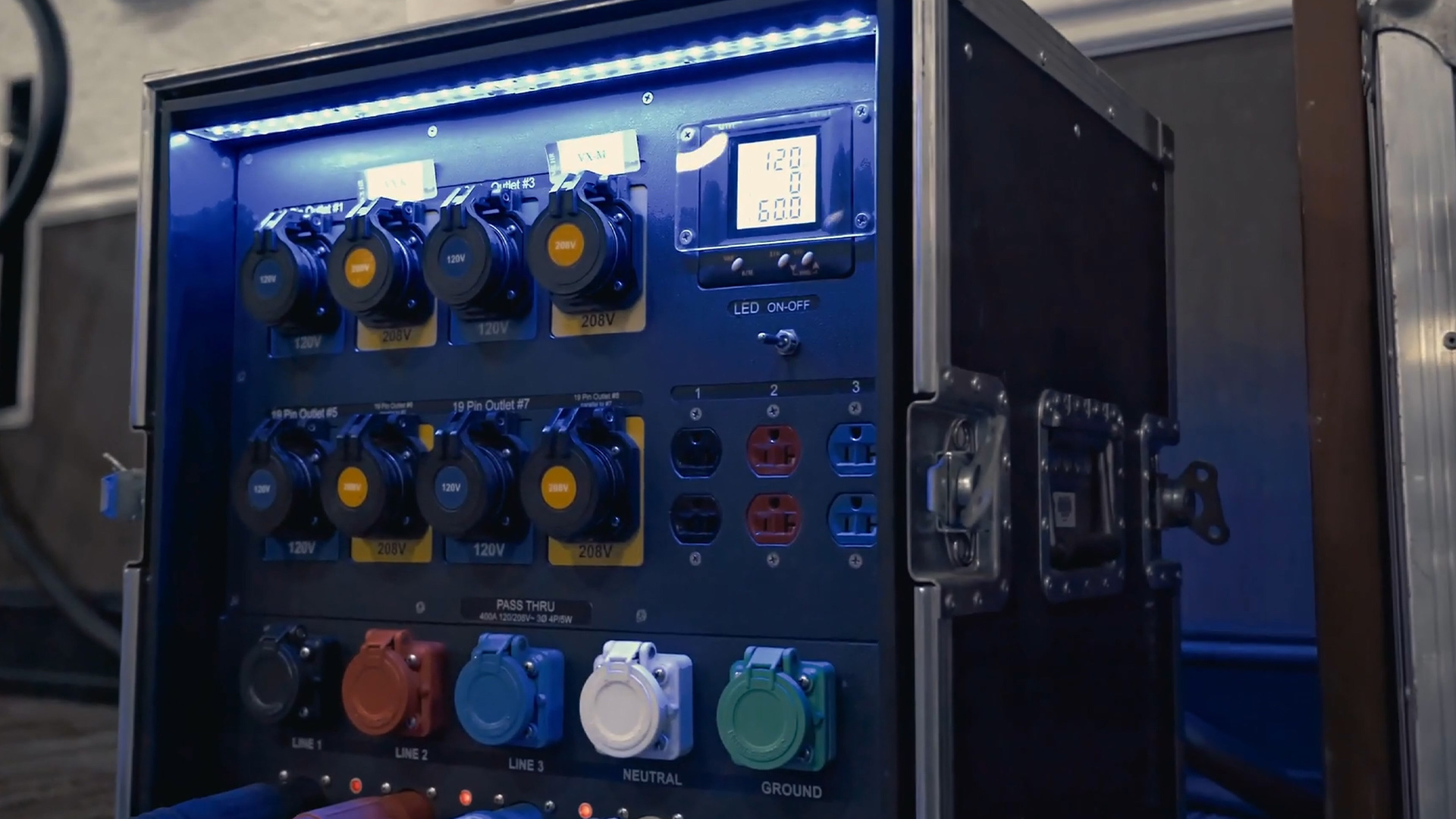
Power phasing errors kill equipment, corrupt audio, create ground loops that inject 60Hz hum into PA systems, and in extreme cases, electrocute crew members. In the context of large event electrical installations, understanding and correctly managing three-phase power distribution is not an optional enhancement to professional practice — it is a foundational safety and performance requirement that every senior AV technician must master.
Three-Phase Power: The Basics Every Technician Must Know
Most large event power supplies are three-phase AC systems, in which three conductors carry alternating current waveforms that are offset by 120 degrees from each other. In a balanced three-phase system, the load is distributed equally across all three phases, the neutral current approaches zero, and the entire system operates at maximum efficiency with minimal heating. In an unbalanced system — which is what most live events inadvertently create when departments randomly request power from the distribution board without phase assignment planning — one or two phases carry dramatically higher loads, generating excess neutral current, elevated conductor temperatures, and in severe cases, neutral conductor failure.
Phase Assignment Planning for Event Rigs
Professional power distribution companies — Aggreko, Total Power International, and GLP Rental — produce detailed phase assignment plans for major events as part of their pre-production service. These plans distribute large loads (audio amplifier racks, LED video processor racks, lighting dimmer racks, and motor control systems) across the three phases with calculated balance tolerances of typically plus or minus ten percent of average phase load. The planning document becomes the authoritative guide for the power distribution technician connecting sub-distribution boards on site.
Ground Loops and Phase Relationships in Audio Systems
The relationship between power phasing and audio quality is more intimate than many non-specialist technicians realize. When audio equipment on different phases shares a common signal ground — as happens routinely when a DiGiCo console on phase A is connected via multicore to a stage box whose power supply is fed from phase B — the phase voltage difference creates a potential difference on the signal ground that manifests as audible hum or buzz in the PA system. Solving this problem requires either strict single-phase assignment for all audio equipment, or the use of Jensen Transformers or Radial Engineering DI boxes with galvanic isolation to break the ground continuity between phases.
Power Factor and Reactive Loads in Event Production
Modern event production equipment — particularly LED video walls, switching-mode amplifiers, and LED lighting dimmer systems — presents non-linear reactive loads to the electrical supply that create power factor correction challenges. A wall of LED video tiles may draw 80 kilowatts of real power but present 120 kVA of apparent power to the generator due to a poor power factor. Aggreko’s event power specialists routinely deploy power factor correction banks alongside generators for large LED-heavy productions to reduce generator reactive load, improve voltage regulation, and reduce fuel consumption.
Testing and Verification Before Load Connection
Before any production equipment is connected to an event power distribution system, the distribution system itself must be fully tested and verified. This involves measuring phase-to-phase voltage balance, testing earth continuity on all distribution points, verifying that the earth leakage (RCD) protection has been installed and is operating at the specified trip threshold (typically 30mA for human contact protection), and confirming neutral conductor integrity. Companies like the Power Behind Events in the UK have developed standardized power testing protocols that are now widely adopted as best practice across the European touring industry.
