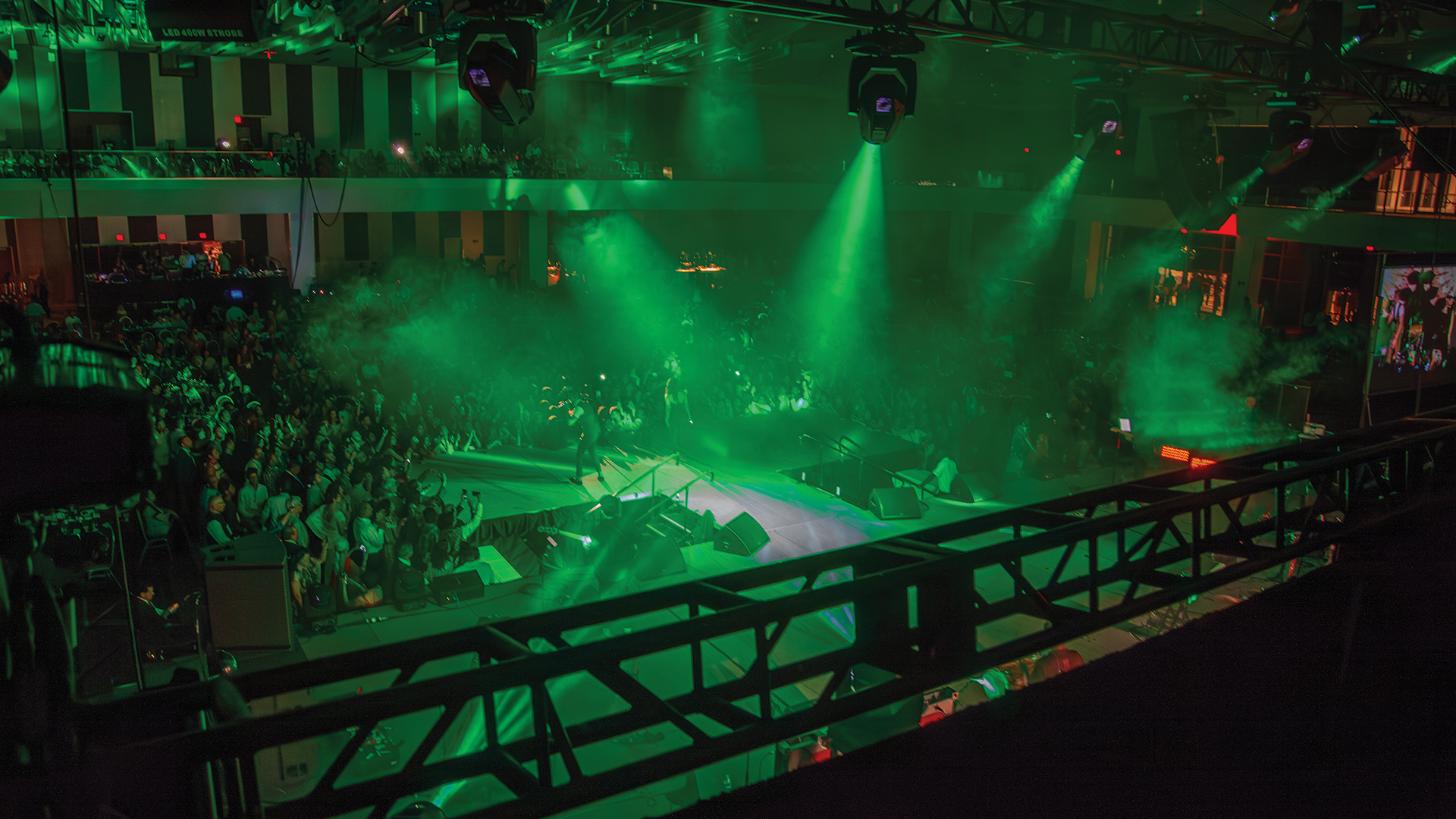
Power distribution for large event rigs is taught at most technical schools as a matter of capacity management — ensuring that the sum of connected loads doesn’t exceed the supply’s rated current. This is the obvious part, and most production electricians manage it competently. What is less consistently understood is phase balancing — the discipline of distributing loads as evenly as possible across all three phases of a three-phase supply — and why a rig that stays within total capacity but loads phases unevenly creates a set of electrical problems that range from nuisance flickering to genuine equipment damage and safety hazards. In large event rigs drawing hundreds of kilowatts from temporary three-phase distribution systems, power phasing is not an electrical theory topic — it is a live operational discipline with direct consequences for the quality of the show and the safety of the crew.
Three Phase Power: The Fundamentals Applied to Events
Three-phase power supplies voltage in three separate AC waveforms offset by 120 degrees from each other — Phase A, Phase B, and Phase C. In a balanced three-phase system where loads are distributed equally across all three phases, the neutral conductor — which carries the return current in single-phase circuits — carries zero current because the three phase currents cancel each other out at the neutral point. This is the engineering elegance that makes three-phase power the standard for large electrical systems: in perfect balance, no current flows in the neutral, eliminating its resistive loss contribution. In an unbalanced system — where, for example, all dimmer loads are on Phase A and all LED fixture supplies are on Phases B and C — the neutral carries the imbalance current, which can heat the neutral conductor beyond its rated capacity and cause voltage fluctuations that affect every device sharing the circuit.
Symptoms of Phase Imbalance in a Live Event Rig
The most immediate symptom of significant phase imbalance in a live event rig is voltage fluctuation between phases. Phase A, loaded more heavily than B and C, will exhibit a lower voltage at the load end of the distribution run due to the voltage drop across the cable resistance. Lighting fixtures on Phase A will appear slightly dimmer than equivalent fixtures on Phase B and C — a difference that becomes visible when the rig transitions to a full white state or a high-intensity look. LED fixtures with switching power supplies tolerate voltage variation relatively well within their specified range; older dimmer-controlled tungsten loads are extremely sensitive to voltage variation, with a 5% voltage drop producing approximately a 15% output reduction and a noticeable colour temperature shift toward warm amber. Digital audio amplifiers — Crown iTech HD, Lab Gruppen PLM+, d&b D80 — are less sensitive to input voltage variation but can produce audible output changes if the voltage variation is rapid and large.
Phase Assignment Strategies for Complex Rigs
The standard phase assignment strategy for a large event rig begins with categorizing loads by type: resistive loads (tungsten lighting, resistance heaters) present no power factor complications; capacitive and inductive loads (motors, transformers, older ballasts) introduce reactive current that affects phase loading calculations differently from their apparent wattage. Modern LED fixture power supplies are largely resistive in character with power factors above 0.9, making their phase loading calculation straightforward. The strategy is to identify the total connected load by type, calculate the phase assignment that minimizes the maximum phase imbalance (aiming for less than 10% difference between the most and least loaded phase), and hard-wire that assignment into the distro configuration. PowerCon and Socapex distribution systems allow this to be done systematically at the distro stage without affecting field wiring.
Harmonics and LED Loads: The Modern Challenge
The widespread adoption of LED fixtures and switching power supply loads has introduced a harmonic distortion problem into large event power systems that didn’t exist when rigs were predominantly incandescent. Switching power supplies draw current in non-sinusoidal pulses — rather than the smooth sinusoidal curve of a resistive load — generating harmonic currents at multiples of the fundamental frequency. Third-harmonic currents (150Hz in a 50Hz system, 180Hz in a 60Hz system) from three-phase switching loads add in the neutral conductor rather than cancelling, creating the counter-intuitive situation where a perfectly balanced three-phase LED rig can overload the neutral conductor. This is why undersized neutral conductors — standard practice in older three-phase wiring designed for resistive loads — must be uprated when serving large LED event rigs. Aggreko and United Rentals temporary power specialists with event experience understand this and spec their distribution accordingly; general commercial electrical contractors without event experience frequently do not.
Measurement and Monitoring
The professional standard for large event power management is real-time power monitoring at the distribution source — measuring per-phase current, voltage, and power factor continuously throughout the event. Power monitoring equipment from Dranetz, Fluke, and Janitza can log all of these parameters to a network interface accessible to the production electrician from FOH or the production office. This monitoring serves both operational safety — alerting to imbalances that approach dangerous levels — and diagnostic purposes, as logged power data allows post-event analysis of exactly when and why electrical anomalies occurred. In an industry where electrical safety incidents carry severe liability consequences, documented evidence that power infrastructure was continuously monitored within safe parameters is also a meaningful risk management asset.
