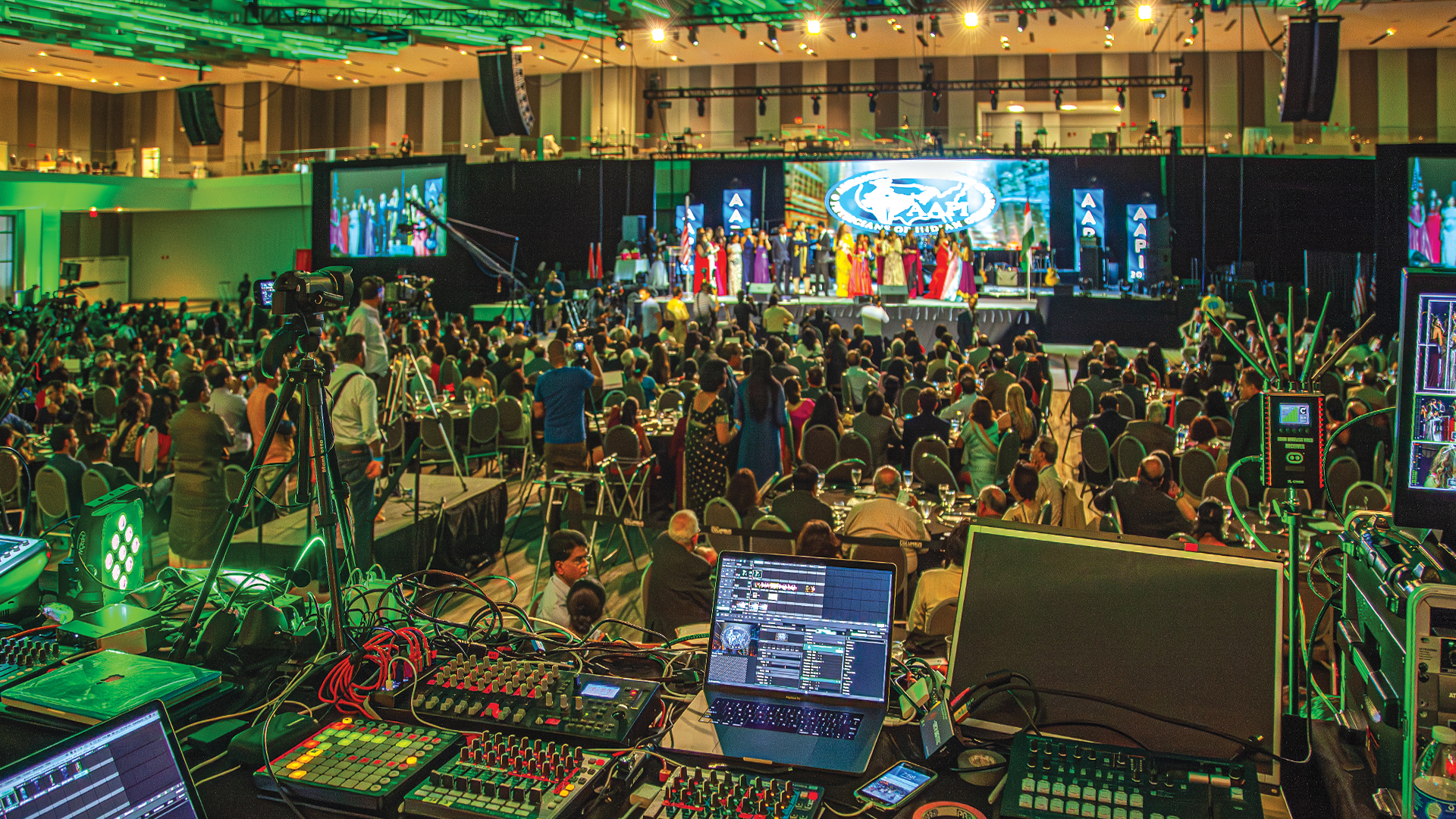
The moment a live stream stutters, buffers, or crashes entirely, thousands of remote viewers experience what in-room audiences never face: complete disconnection from the event they paid to attend. In 2024’s hybrid event landscape, where virtual attendance often exceeds physical presence by factors of ten or more, technical bottlenecks represent existential threats to event success. The production teams that consistently deliver flawless streams don’t rely on luck—they engineer redundancy, anticipate failure points, and build systems that gracefully degrade rather than catastrophically collapse.
Bandwidth: The Foundation Everyone Underestimates
Most streaming failures trace back to insufficient or unstable upload bandwidth. Production teams frequently test venue internet during site visits, confirm adequate speeds, then watch helplessly as those speeds evaporate during the actual event when hundreds of attendees connect simultaneously. The solution requires dedicated circuits—not promises of priority from venue IT departments, but physically separate internet connections exclusively reserved for production streaming.
Professional productions typically demand bonded cellular connections as primary or backup pathways. LiveU LU800 units have become industry standard equipment, combining multiple 5G and LTE connections into aggregated pipelines capable of maintaining broadcast-quality streams even when individual cellular carriers experience congestion. The original LiveU technology emerged from Israeli military video transmission needs, and that DNA shows in the product’s resilience under adverse conditions. Running a LiveU alongside dedicated fiber creates the redundancy that separates amateur streams from professional broadcasts.
Encoding: Where Compression Meets Reality
The video encoder stands as the critical translation point between high-quality production feeds and deliverable internet streams. Push too much bitrate through limited bandwidth, and packets drop. Compress too aggressively, and visual quality crumbles into pixelated mush during high-motion segments. Finding the sweet spot requires understanding both the technical capabilities of encoding hardware and the consumption patterns of target audiences.
Hardware encoders like the Teradek Prism or AJA HELO Plus handle encoding duties with dedicated processing that won’t compete with other production software for system resources. These units support HEVC/H.265 encoding, which delivers equivalent visual quality at roughly half the bitrate of older H.264 codecs a meaningful advantage when bandwidth proves constrained. Software encoding through vMix or OBS Studio offers flexibility for smaller productions, though dedicated encoding hardware remains preferable for mission-critical streams.
Adaptive Bitrate: Serving Every Connection Quality
Adaptive bitrate streaming (ABR) transformed live streaming from an all-or-nothing proposition into graceful degradation. Rather than delivering a single stream quality that either works or fails completely, ABR protocols encode multiple quality levels simultaneously typically 1080p, 720p, 480p, and 360p variants. Viewer devices automatically select the highest quality their current connection supports, seamlessly shifting between quality levels as network conditions fluctuate.
Implementing ABR requires either multi-bitrate encoding on the production side or transcoding through content delivery networks. Platforms like Vimeo Livestream, IBM Video Streaming, and AWS Media Services handle transcoding automatically, accepting single high-quality ingest streams and generating multiple output variants. This approach reduces production complexity while ensuring worldwide audiences receive appropriate quality for their connections—critical when events draw international viewership across wildly varying internet infrastructure.
The Video Switching Bottleneck
Production switchers represent another common failure point, particularly when underpowered systems attempt to handle multiple inputs, graphics overlays, and streaming outputs simultaneously. A Blackmagic ATEM Mini handles simple productions adequately, but complex multi-camera shows with picture-in-picture layouts, lower thirds, and animated transitions demand more substantial hardware. The Ross Carbonite series or Sony XVS-G1 production switchers provide the processing headroom that prevents dropped frames during intensive switching sequences.
GPU acceleration has become essential for productions incorporating real-time graphics. Systems running Notch or Unreal Engine for generative backgrounds or data visualization overlays require dedicated graphics cards—typically NVIDIA RTX 4090 or professional Quadro series GPUs to prevent rendering bottlenecks from propagating into stream quality issues.
Audio: The Forgotten Stream Killer
Viewers tolerate mediocre video far longer than compromised audio. Crackling, distortion, dropout, or sync issues drive audiences away faster than resolution problems ever could. Yet audio infrastructure frequently receives secondary attention during stream planning, leading to preventable failures during broadcasts. The audio signal chain demands the same redundancy thinking applied to video pathways.
Professional productions run multiple audio paths from stage to stream encoder. Primary feeds typically flow through broadcast-grade mixing consoles—Yamaha CL5 or DiGiCo SD series—with dedicated broadcast mix outputs isolated from front-of-house PA feeds. Backup audio might come from a secondary mixer handling redundant microphone splits, or from direct stage box feeds that bypass the primary console entirely. Dante audio networking has simplified multi-path audio distribution, allowing numerous devices to tap the same sources without complex analog splitting.
Content Delivery Network Strategy
Even perfect production-side encoding means nothing if content delivery networks (CDNs) can’t distribute streams to global audiences efficiently. CDNs operate edge servers positioned near viewer populations, caching stream content closer to consumption points to minimize latency and prevent origin server overload. Selecting appropriate CDN partners—and configuring proper redundancy between them—determines whether thousands of simultaneous viewers experience smooth playback or buffering nightmares.
Akamai, Cloudflare Stream, and Amazon CloudFront dominate enterprise streaming infrastructure. Production teams often employ multi-CDN strategies, distributing viewer loads across multiple providers to prevent single points of failure. Services like Mux or Wowza Streaming Cloud abstract CDN management entirely, automatically routing viewers to optimal delivery paths while handling failover transparently. This architectural approach costs more than single-CDN deployment but provides the resilience essential for high-stakes broadcasts.
Monitoring: Seeing Problems Before Viewers Do
Proactive stream monitoring separates reactive crisis management from preventive problem resolution. Real-time dashboards tracking bitrate stability, frame drops, encoder health, and CDN performance enable technical directors to identify degradation before audiences notice. When metrics start trending toward failure thresholds, teams can execute failover procedures or make quality adjustments preemptively.
Tools like Touchstream or Conviva provide enterprise-grade monitoring with historical analysis capabilities. Smaller productions might rely on platform-native analytics from YouTube Studio or Vimeo’s built-in metrics. Regardless of tooling sophistication, the principle remains constant: visibility enables response. Teams flying blind discover problems only when social media complaints start flooding in—far too late to salvage viewer experience.
Rehearsal: The Ultimate Bottleneck Prevention
Technical rehearsals specifically focused on streaming infrastructure reveal bottlenecks that never surface during standard show rehearsals. Running full bandwidth loads, simulating failover scenarios, and stress-testing encoding systems under realistic conditions exposes weaknesses addressable before audiences log in. These technical dry runs should mirror actual event conditions as closely as possible—same time of day to capture realistic venue internet congestion, same graphics package rendering, same multi-camera switching complexity.
The 1999 Victoria’s Secret online fashion show famously crashed when 1.5 million simultaneous viewers overwhelmed servers—a cautionary tale that predated modern streaming infrastructure by decades but established a principle still relevant today. Every assumption about capacity requires validation through testing. Every backup pathway needs activation under controlled conditions. Every failover procedure deserves practice execution before stakes become real.
Building Resilient Streaming Architecture
The streaming productions that consistently deliver flawless broadcasts share architectural philosophies rather than identical equipment lists. They assume failure will occur and design systems that survive component loss. They monitor obsessively and respond proactively. They test rigorously and document thoroughly. They staff appropriately—dedicated stream engineers alongside traditional AV crews rather than expecting video operators to manage streaming responsibilities simultaneously.
As hybrid events evolve from pandemic necessity into permanent production format, the organizations investing in streaming infrastructure quality will capture competitive advantages impossible to replicate through content alone. Audiences remember seamless viewing experiences and abandon producers who subject them to technical frustration. The bottlenecks detailed throughout this examination are entirely preventable with proper planning, appropriate technology investment, and operational discipline. The question isn’t whether prevention is possible—it’s whether production teams will prioritize the invisible infrastructure that makes visible success achievable.
