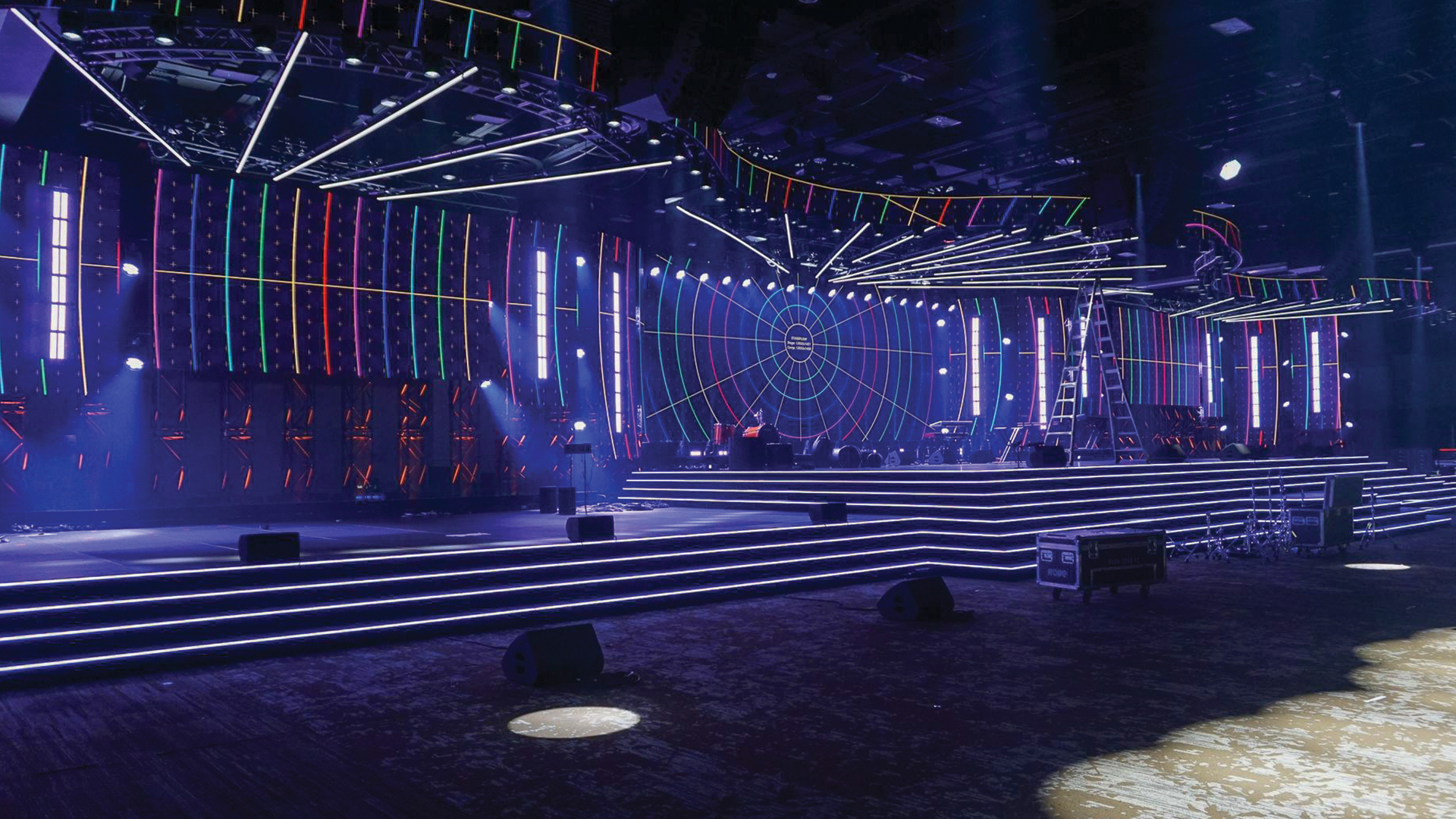
The first time I witnessed a 120fps music video playing across a curved ROE Visual Black Pearl LED wall at a corporate product launch in Las Vegas, the difference was unmistakable. Every dancer’s movement remained crisp during rapid choreography. The client’s CEO walked across the stage while their brand story unfolded behind them, and not a single motion artifact disrupted the visual flow. That moment crystallized something I’d been researching for months: high frame rate (HFR) content isn’t just a technical upgrade—it’s becoming essential for professional LED wall installations.
The Physics Behind Frame Rate and LED Perception
Understanding why frame rate matters for LED walls requires diving into how these displays fundamentally differ from projection. Traditional cinema established 24fps as the standard because film projectors used mechanical shutters that introduced natural motion blur. This blur actually helped mask the gaps between frames. LED walls operate entirely differently—each pixel is a discrete light source that switches on and off with remarkable precision, typically refreshing at rates between 3840Hz and 7680Hz on professional panels from manufacturers like Absen and Unilumin.
This ultra-fast refresh rate means the display can faithfully reproduce whatever frame rate you feed it—but feeding it 24fps or even 30fps content creates a peculiar visual phenomenon. The display is technically capable of showing each frame for exactly the right duration, but the human eye perceives the discrete jumps between frames more readily on emissive displays. Camera operators shooting LED walls discovered this problem early in the virtual production revolution, when shows like The Mandalorian pushed the boundaries of what LED volumes could achieve.
Historical Context: From Showscan to Modern HFR
The pursuit of higher frame rates predates LED technology by decades. Douglas Trumbull, the visual effects pioneer behind 2001: A Space Odyssey and Blade Runner, developed Showscan in the 1970s—a 60fps 70mm format that delivered unprecedented clarity and immersion. Trumbull conducted extensive research showing that audiences experienced heightened emotional responses at higher frame rates, with physiological measurements confirming increased engagement. His work influenced theme park attractions and specialty venues but never achieved mainstream adoption due to the enormous costs of shooting and projecting 70mm film at double the standard rate.
Peter Jackson revisited this territory with The Hobbit trilogy in 2012, shooting at 48fps for digital projection. Critics and audiences had mixed reactions—some found the hyper-real imagery disconcerting, describing it as looking like a television broadcast rather than cinema. This reaction stemmed partly from unfamiliarity but also from a genuine aesthetic question: when does clarity become clinical? For LED wall applications in live events, that question answers itself differently than it does for narrative cinema.
Practical Implementation: Media Server Considerations
Delivering HFR content to LED walls demands robust media server infrastructure. A disguise gx 3 server can handle 60fps playback across multiple outputs with headroom to spare, but pushing to 120fps requires careful codec selection and drive configuration. The HAP Q codec remains popular for live events because it enables real-time playback without taxing the CPU, though it produces larger file sizes than ProRes or H.265. Brompton Technology processors on the receiving end need configuration to match the incoming frame rate, and genlock synchronization becomes critical to avoid tearing artifacts.
Content creators working with tools like Notch or TouchDesigner can generate real-time graphics at variable frame rates, adjusting output based on system performance. This flexibility proves invaluable for corporate events where last-minute changes are inevitable. A Notch Block inside disguise can render particle effects or data visualizations at 60fps while the media server handles pre-rendered video at the same rate, maintaining visual consistency across all content types.
The Camera Factor: Why Broadcast Demands HFR
Events with IMAG (image magnification) or broadcast components face additional challenges. A camera capturing the stage at 59.94fps will create visible beat frequencies with an LED wall displaying 30fps content—the mathematical relationship produces a visible flicker or roll that no amount of post-processing can fully eliminate. Switching the LED content to 59.94fps matches the camera’s capture rate, eliminating these interference patterns. This synchronization becomes even more critical for XR (extended reality) productions where cameras must capture both talent and LED backgrounds without visible artifacts.
Productions using Sony Venice or RED Komodo cameras in LED volumes typically operate at either 23.976fps or 47.952fps for final delivery, but the LED wall refresh and content frame rate must be carefully managed to avoid moiré patterns. The Mo-Sys StarTracker system feeding positional data to the Unreal Engine render cluster adds another timing consideration—the entire signal chain from camera tracking to wall display must maintain frame-accurate synchronization.
Content Creation Workflow Adjustments
Producing HFR content requires rethinking traditional motion graphics workflows. After Effects projects need composition settings adjusted from 30fps to 60fps, which doubles render times and storage requirements. Text animations that looked smooth at 30fps might appear to crawl at 60fps because each position change is halved. Motion blur settings require recalibration—the default samples-per-frame values that worked for lower frame rates produce insufficient blur at higher rates, making motion feel unnaturally sharp.
Cinema 4D and Blender artists rendering 3D content for LED walls often output at 60fps with extra motion blur subframes enabled. The Redshift and Octane renderers handle this efficiently with GPU acceleration, but render farm budgets must account for the doubled frame count. Some studios maintain separate project versions—a 30fps master for archival and web delivery, and a 60fps version specifically for LED wall deployment.
Real-World Performance: Case Studies
A major automotive manufacturer’s international dealer conference demonstrated the practical benefits of HFR content convincingly. The reveal moment featured their new electric vehicle emerging through a digital tunnel rendered in Unreal Engine 5 at 60fps. The camera movement tracked smoothly around the car as digital environments dissolved and reformed. Previous years’ presentations using 30fps content had prompted complaints about motion judder during similar reveals—this year, attendee feedback specifically praised the visual smoothness of the LED presentations.
Concert touring represents another compelling use case. When a major pop artist’s world tour upgraded their LED content from 30fps to 60fps, the production team reported that footage of the performer captured during rehearsals and integrated into the show played back with notably improved quality. Movement matched the live performance more naturally, creating a more cohesive visual experience. The additional storage and rendering costs—roughly 40% higher across the production—were deemed worthwhile for the improved audience experience.
Technical Specifications and Standards
The SMPTE ST 2110 standard governs professional video transport over IP networks and accommodates frame rates up to 120fps. Facilities building new LED wall infrastructure should consider this headroom even if current productions only require 60fps. SDVoE (Software Defined Video over Ethernet) systems from ZeeVee and Semtech support HFR signals with minimal latency, critical for live event applications where delay between content server and display must remain imperceptible.
The HDMI 2.1 specification enables 4K at 120fps or 8K at 60fps, finally bringing consumer interfaces into the HFR realm. While professional installations typically rely on 12G-SDI or fiber, hybrid events incorporating consumer displays benefit from this expanded capability. DisplayPort 2.0 pushes bandwidth even further, supporting 16K resolution at 60fps—future-proofing that today’s most demanding LED installations can’t yet exploit but tomorrow’s might.
Looking Forward: The 120fps Frontier
Gaming and esports venues are pushing toward 120fps as standard. Competitive gamers perceive input lag and motion artifacts that casual viewers miss, making ultra-high frame rates a genuine competitive requirement. LED walls in esports arenas displaying game feeds benefit from matching the capture and display rates to the game’s internal rendering. A League of Legends tournament displayed on screens running at 120Hz with 120fps capture creates a noticeably sharper experience than the same game shown at broadcast-standard 60fps.
The technology continues advancing rapidly. MicroLED panels from Samsung and Sony Crystal LED push pixel pitch below 1mm while maintaining refresh rates that support HFR content beautifully. The convergence of increased processing power, improved compression codecs, and expanded network bandwidth makes 60fps the new baseline, with 120fps emerging for premium applications. Event producers who embrace this shift position themselves to deliver experiences that simply weren’t possible five years ago—smooth, immersive, and unmistakably superior to what audiences have come to expect.
The investment in HFR workflows pays dividends beyond immediate visual improvement. Content produced at higher frame rates can be time-remapped more effectively for slow-motion sequences, provides better source material for AI-powered frame interpolation, and maintains compatibility with future display technologies that will inevitably demand higher temporal resolution. Starting with HFR as the production standard rather than treating it as an upgrade positions creative teams for whatever comes next in the rapidly evolving landscape of LED wall technology.
