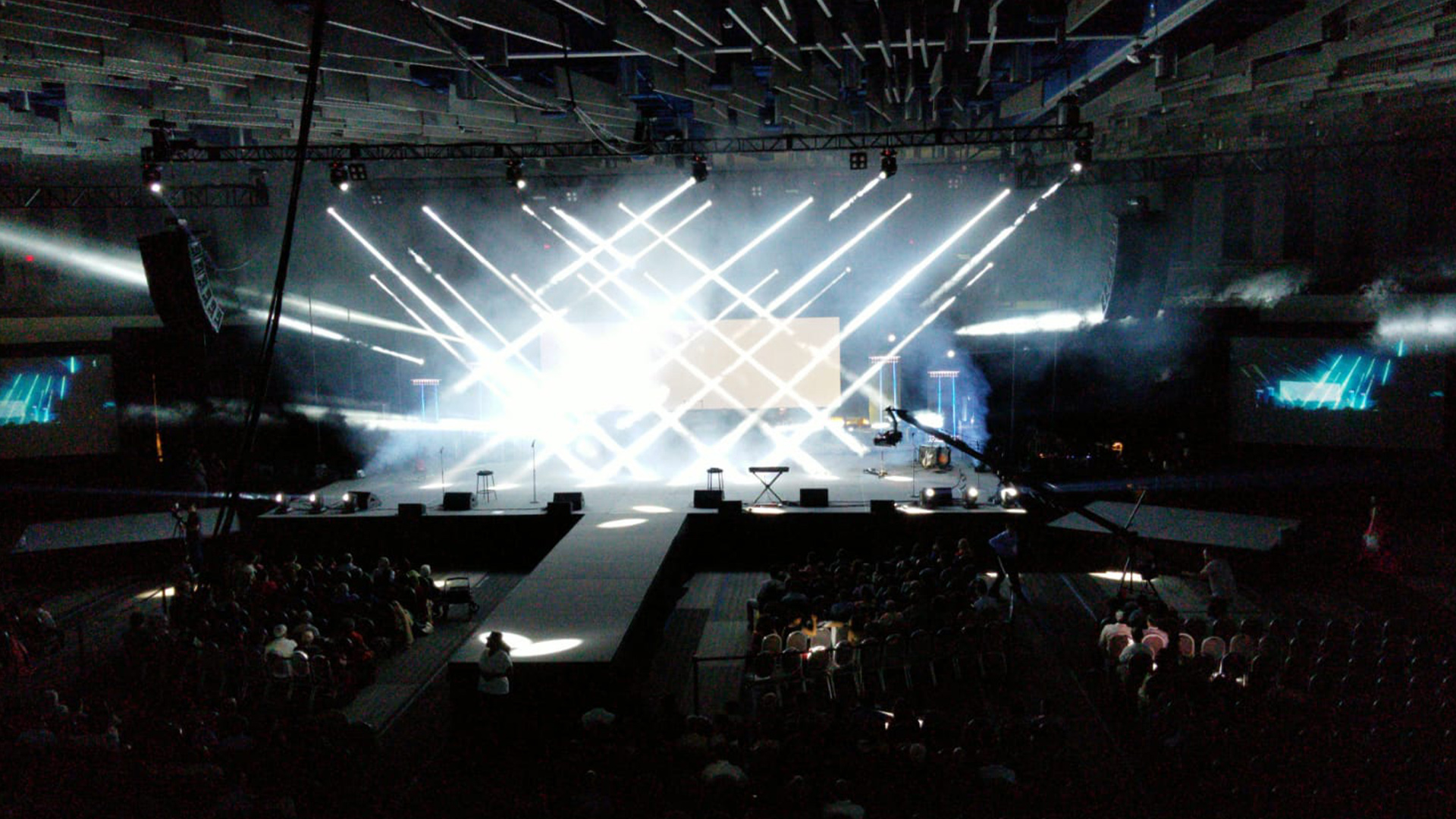
When you add up every touring concert, festival main stage, arena show, stadium event, corporate summit, broadcast production, and outdoor amphitheater performance served by JBL Professional, d&b audiotechnik, and L-Acoustics systems in a single calendar year, the aggregate number of events comfortably exceeds 10,000. These three companies — each founded in a different country, across a span of nearly 70 years, from different engineering philosophies — collectively define the sound of live entertainment across six continents. Their rivalry is one of the most intensely contested competitive dynamics in professional technology manufacturing, and the innovations it drives are continuously raising the standard of what a large-format PA system can achieve.
Three Companies, Three Philosophies
JBL Professional, founded in Los Angeles in 1946, built its technical identity on transducer design: voice coil engineering, diaphragm materials, and magnet structures that achieve maximum acoustic output per unit of applied power. The company’s 70+ years of transducer research are embedded in every VTX and SRX component. d&b audiotechnik, founded in Straubenhardt, Germany in 1981, built its technical identity on DSP integration: the idea that a professional PA system is a holistic engineered system in which electronics, acoustics, and software are co-designed rather than assembled from independently developed components. The d&b J-Series’ integration of amplification, processing, and mechanical design in a single certified system is the most mature expression of this philosophy. L-Acoustics, founded in Marcoussis, France in 1984 by Dr. Christian Heil, built its technical identity on array theory: the mathematical understanding of how multiple speaker elements combine to produce controlled, predictable coverage patterns that can be designed and verified with precision.
The 10,000-Show Reality: What Deployment at Scale Means
A PA system deployed across 10,000 shows is exposed to a range of operational conditions that no controlled testing environment can simulate. The transducer that survives 200 identical 18-hour days of moderate-level output in a test laboratory may behave very differently when exposed to a single 12-hour day of tour-level drive followed by 24 hours of freight vibration, followed by immediate deployment in a high-humidity tropical environment. The reliability data that production companies accumulate across large deployment numbers — failure rates per 1,000 operating hours, mean time between failures for specific component types, failure mode distributions — is the most valuable quality intelligence any manufacturer can receive. The production companies that share this data with their equipment suppliers — typically through confidential field service reports — are participating in a continuous product improvement cycle that benefits the entire industry.
Service Network: The Infrastructure Behind 10,000 Shows
The ability of JBL, d&b, and L-Acoustics to support 10,000+ shows worldwide simultaneously is a function of their respective global service and distribution networks. JBL’s Harman International infrastructure maintains factory-authorized service centers in 47 countries, with stocked component inventories at regional distribution hubs. d&b audiotechnik operates through a network of exclusive national distributors — one per major market — who maintain service capability and parts inventory within their territories. L-Acoustics deploys its Rental Network system of globally authorized L-Acoustics Certified Provider (LACP) rental companies, each maintaining a minimum stocked inventory and certified technical staff that the company periodically audits. The three models represent different philosophies of service infrastructure design, but all three achieve the fundamental requirement: a system failure anywhere in the world can be addressed by certified technical expertise within a commercially acceptable timeframe.
Competitive Innovation: The Race That Benefits Users
The competitive dynamic between JBL, d&b, and L-Acoustics has produced a pace of innovation in professional PA technology that would not be achievable if any single company dominated the market without competition. The introduction of L-Acoustics P1/P1+ system controllers directly inspired d&b to accelerate the development of their R1 Version 4 enhanced measurement integration, which in turn influenced JBL’s HiQnet Performance Manager v3 feature roadmap. The d&b SL-Series optimized cabinet geometry for packing density influenced L-Acoustics’ redesign of K-Series transport packaging. JBL’s Crown I-Tech HD amplifier integration prompted both d&b and L-Acoustics to enhance their respective amplifier management features. Each innovation from one company creates competitive pressure on the others to respond — a dynamic that has produced three product generations of improvement in the past decade.
The Market Reality: Who Wins in Different Segments
While all three companies deploy at the 10,000-show scale, each commands stronger market positions in specific event segments. L-Acoustics holds the strongest position in European touring and festival productions, where the company’s French origins have created a strong engineering culture relationship with major European production companies including Delta Sound, ESS Audio, and GP Services. d&b audiotechnik’s strongest market position is in installed systems — sports arenas, convention centers, and performing arts venues — where the company’s Soundscape immersive audio processing and its reputation for sound quality precision have created a loyal specifier community. JBL’s strongest position is in the North American touring market and globally in the EDM festival sector, where the VTX system’s combination of output capability and deployment breadth aligns with the format’s production requirements.
The Impact on 10,000 Audiences: The Human Measure
The engineering competition between JBL, d&b, and L-Acoustics ultimately serves an audience measured not in equipment deployments but in human beings: the 10,000 × 20,000 = 200 million audience experiences across these shows in a single year. Every improvement in SPL consistency is an improvement in the experience of the fan in the last row of the upper tier. Every improvement in transducer reliability is one fewer interrupted show. Every improvement in DSP processing is a corresponding improvement in the intelligibility of a lyric, the impact of a drop, the emotional weight of a climactic musical moment. The manufacturers compete on technical specifications and market share; the audience benefits through the universal language of well-reproduced live sound.
What 10,000 Shows Predict About the Next Decade
The aggregate intelligence of 10,000 shows per year provides JBL, d&b, and L-Acoustics with a data resource for product development that no other market segment provides at comparable scale. The shift toward IP audio transport, the adoption of cloud-based system management, the integration of machine learning into acoustic prediction and system optimization, and the application of sustainable materials in enclosure construction are all development directions that the companies are pursuing with data from real-world deployments guiding the priorities. The next decade of professional PA development will be shaped by the intelligence accumulated from these 10,000 annual show deployments — and the three companies that process this intelligence most effectively will define the sound of live entertainment for the generation that follows.
