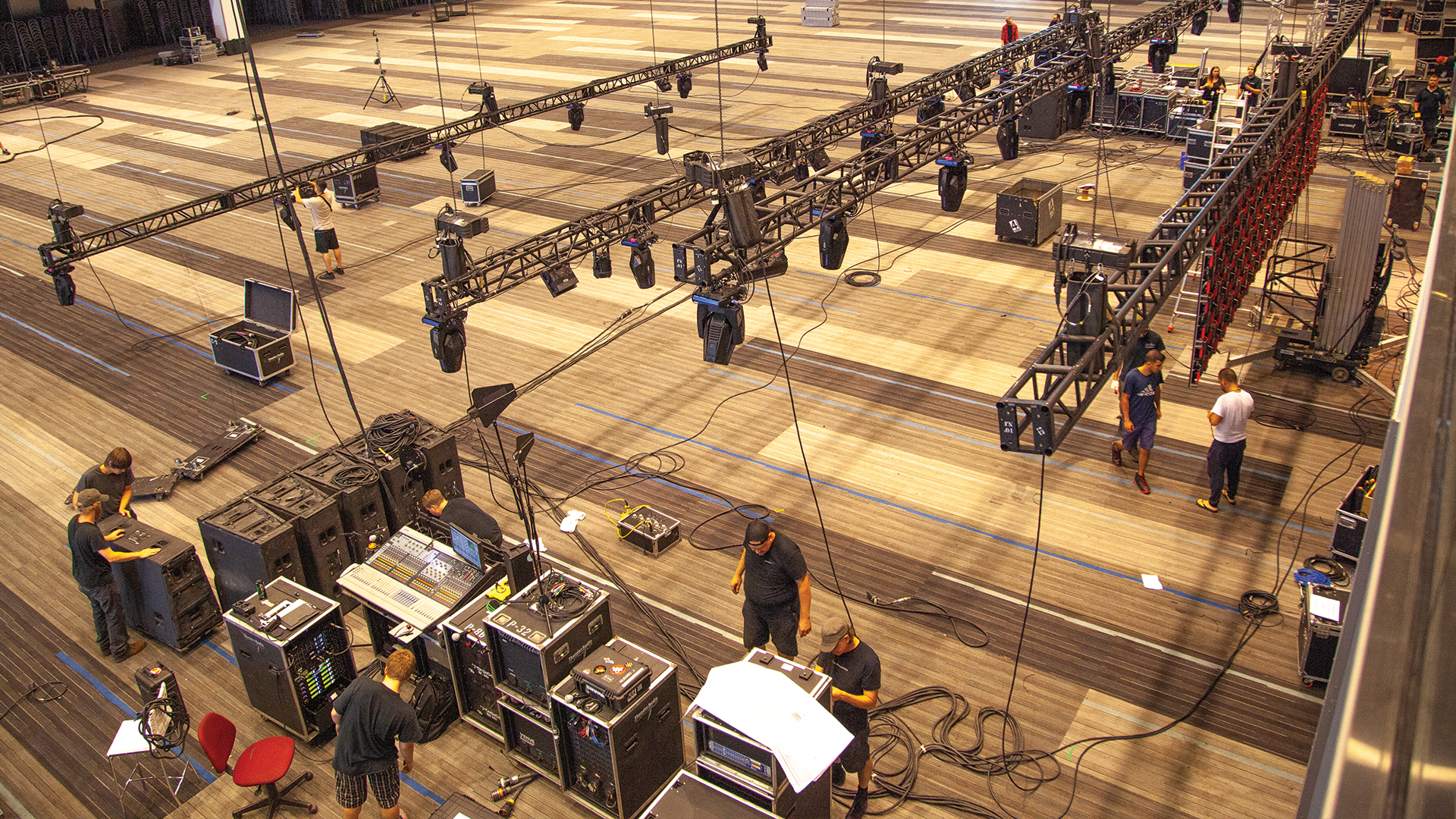
The aluminum trussing that supports modern production rigs performs its job silently, holding tonnage of lighting fixtures, LED panels, and audio components without complaint. Until it doesn’t. These are the stories of rigging systems that decided to express their concerns about working conditions.
The Tyler Truss Thermal Expansion Event
The Tyler Truss GT system provides robust structural support for touring productions. Rigging director Carlos Mendez deployed a GT configuration for an outdoor summer tour and discovered the limits of theoretical calculations.
“We had a 120-foot span of 20.5-inch truss supporting the main lighting rig—maybe 4,000 pounds distributed load, well within ratings. The chain motors were CM Lodestar 1-ton units on proper bridles. Everything by the book. Then the afternoon Arizona sun hit the rig.”
The aluminum truss, heating to over 140°F under direct sunlight, began expanding. “We measured thermal growth of nearly two inches across that span. The truss started groaning as the expansion fought against the fixed pickup points. The spigot connections were binding, pins were seizing. We had to call a hold and let the rig cool before we could safely make any adjustments.”
Engineering the Solution
Mendez redesigned the rigging approach. “We implemented expansion joints at strategic points—basically allowing the truss to grow without fighting itself. We also switched to early morning load-ins and installed temporary shade structures over the rig until show time. The truss had taught us that thermal management matters as much as load management.”
The Prolyte Vibration Protest
The Prolyte H30V truss offers excellent strength-to-weight ratio for touring applications. Head rigger Amanda Foster encountered a H30V configuration that developed opinions about bass frequencies during a heavy metal tour.
“The rig was conventional—60-foot spans supporting moving heads and strobes. Loading was maybe 60% of rated capacity. But during the first show, when the bass dropped into that subwoofer-dominant breakdown section, the entire rig started resonating.”
The resonance wasn’t dangerous, but it was visible. “You could see the truss oscillating—maybe half an inch of movement at the midpoints. The Martin MAC Viper fixtures were visibly swaying. We were hitting the natural frequency of that particular span configuration, excited by the subwoofer output from the arrays below.”
Damping the Dance
The solution combined structural and acoustic approaches. “We added mass dampers—essentially sandbags positioned at the resonance nodes—and worked with the audio team to apply parametric filtering to the specific frequency range causing excitation.”
Historical Context: The Evolution of Entertainment Rigging
The history of stage rigging traces back to the counterweight systems of Renaissance theater. The hemp house system—ropes, pulleys, and human muscle—served theatrical productions for centuries before modern alternatives emerged.
The introduction of aluminum box truss in the 1970s revolutionized rock and roll touring. Companies like James Thomas Engineering (now part of Prolyte Group) developed standardized truss systems that could be rapidly assembled and trusted to support growing lighting rigs. The SuperTruss and Pre-Rig Truss concepts enabled the massive productions we see today.
The Total Structures Stress Fracture Discovery
Even the most robust truss systems can develop hidden problems. Production manager Daniel Chen discovered this during a routine pre-rig inspection of a Total Structures T4 system that had served a major tour for three years.
“We had a certified rigger doing the quarterly inspection when they noticed unusual discoloration at a weld joint. Under dye penetrant testing, we found a stress fracture propagating from a microscopic weld defect. The truss had been silently failing for who knows how long, holding shows together on progressively fewer good welds.”
Implementing Comprehensive Inspection Protocols
The discovery prompted Chen to implement more rigorous inspection protocols. “We now use ultrasonic testing on critical welds annually. The cost is significant—maybe $200 per truss section for comprehensive NDT—but finding a failure before it happens is priceless.”
The Global Truss Load Cell Revelation
Modern rigging increasingly incorporates load monitoring systems that give truss a voice. Rigging supervisor Maria Santos deployed a Global Truss F34 system with Broadweigh load cells on every pickup point for a corporate show with exacting safety requirements.
“The load monitoring system gave us real-time feedback that revealed load distribution issues we’d never have caught otherwise. One motor was carrying 40% more than its neighbors—a bridle angle issue that looked correct visually but was measurably wrong.”
Santos now advocates for load monitoring as standard practice. “The BroadWeigh Log100 system gives continuous data throughout the show. We’ve caught motors developing problems, discovered thermal loading changes we didn’t anticipate, and identified wind load impacts that exceeded our calculations.”
Tomcat Truss and the Pin Problem
The Tomcat Truss systems maintain their reputation through robust construction. Head rigger Jason Park encountered a systematic pin failure that progressed across multiple tour stops.
“We started finding bent conical pins during strikes—nothing dramatic, just slight bowing. Over three weeks, the problem spread. Pins that were fine at the start of the tour were bending by the end.”
Investigation revealed the cause. “A single truss section had a spigot bore that was very slightly out of spec—maybe 0.008 inches oversized from wear. When connected, it allowed just enough angular movement to stress the pins asymmetrically. One bad section was slowly damaging every pin that connected to it.”
Practical Rigging Maintenance Strategies
Preventing truss strikes requires systematic attention to maintenance, inspection, and documentation. The foundation is a comprehensive truss inventory system that tracks every section through its service life, recording shows, inspections, and any noted issues.
Regular visual inspection should happen at every load-in, looking for bent chords, cracked welds, damaged connectors, and worn hardware. More comprehensive inspection—including NDT methods like dye penetrant and ultrasonic testing—should occur annually or after any incident.
Environmental Considerations
Outdoor deployments require additional attention to environmental factors. Temperature extremes affect both structural integrity and hardware function. Wind loading calculations become critical when soft goods or solid elements are attached to truss structures. The ESTA/ANSI E1.2 standard provides guidance on entertainment rigging practices that every production should follow.
Training riggers to recognize early warning signs—unusual sounds, visible deflection, resistance during assembly—empowers them to stop problems before they escalate. The truss will tell you when it’s unhappy if you know how to listen.
Every truss system carries the weight of artistic vision and the responsibility for human safety. The structures that serve productions best are the ones that receive the respect, maintenance, and careful attention their critical role demands. When truss goes on strike, it’s usually because the warning signs were missed.
