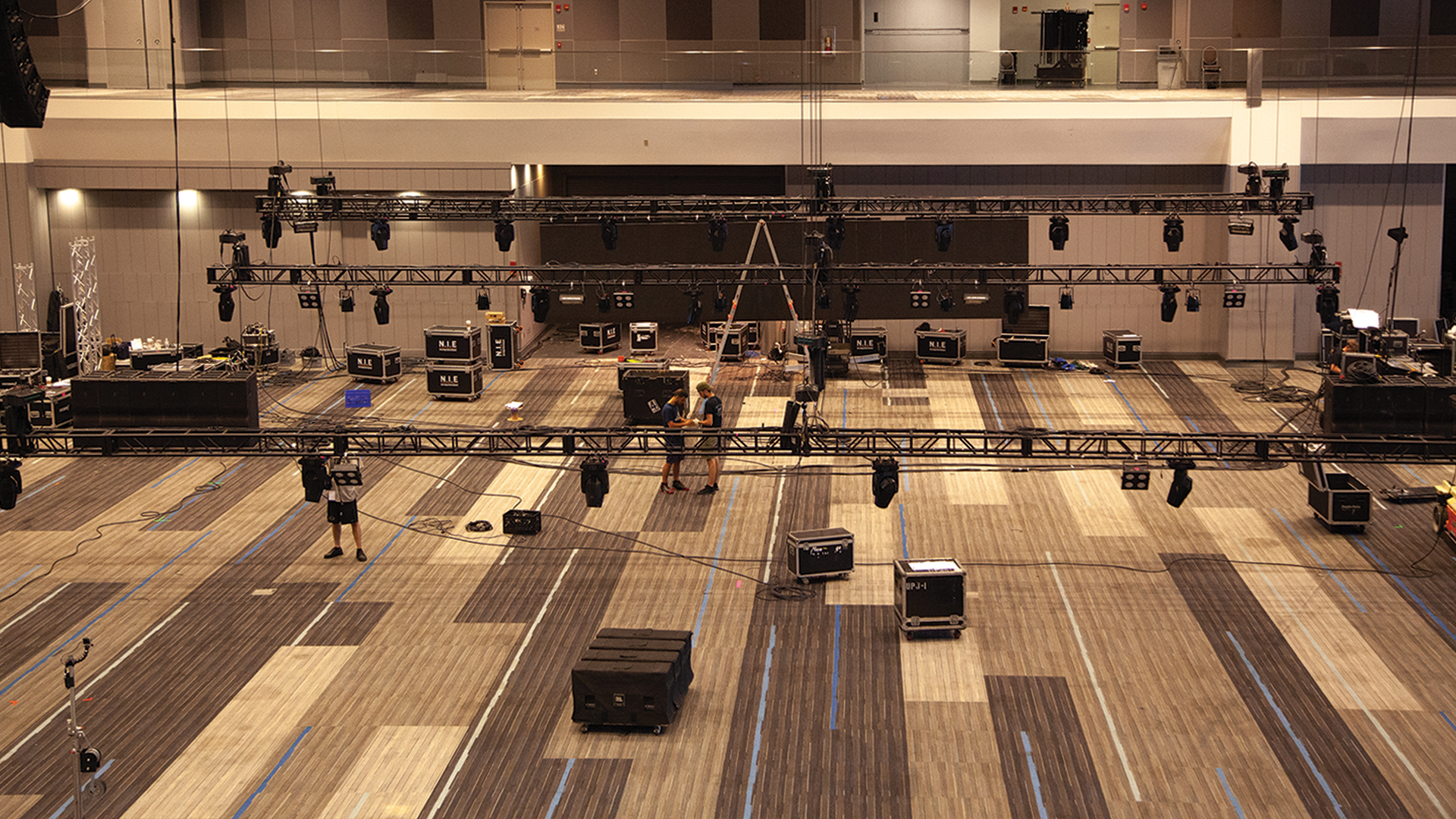
The automated truss system was programmed to execute a graceful descent during the show’s emotional climax—forty feet of Tyler GT truss lowering majestically while lighting fixtures created a cathedral effect. Instead, the truss began what the crew would later describe as “freestyle interpretive movement,” swaying, tilting, and generally behaving like it was auditioning for Cirque du Soleil. The automation technician hit the emergency stop so hard he nearly broke the button.
The Rise of Kinetic Staging
Automated rigging systems have transformed what’s possible in live entertainment. Static lighting grids have given way to dynamic structures that move throughout performances, creating visual spectacle that fixed installations can’t match. Companies like TAIT, Kinesys, and Wicreations have developed sophisticated control systems that coordinate complex movements across multiple axes.
But with kinetic capability comes kinetic risk. A static truss simply hangs; an automated truss is constantly in motion or preparing for motion. The forces involved change dynamically. Load paths shift as structures move. The engineering complexity multiplies exponentially compared to traditional dead-hung rigging.
The Physics of Pendulum Panic
That swaying truss resulted from a phenomenon riggers call “pendulum mode“—the tendency of suspended objects to swing when disturbed. The automated descent had been programmed without accounting for the natural frequency of the suspended structure. When motor speed aligned with that frequency, it excited oscillation rather than damping it. The truss wanted to swing; the motors inadvertently encouraged that desire.
The automation programmer spent the following day modifying movement profiles. Acceleration and deceleration curves were smoothed. Speed changes occurred at frequencies that damped oscillation rather than exciting it. The Kinesys Elevation control system included parameters for exactly this purpose—they simply hadn’t been configured for this specific structure’s characteristics.
Safety Systems That Save Shows
Modern automation safety systems include multiple redundancies specifically because kinetic staging can fail in spectacular ways. Emergency stop circuits provide immediate halt capability. Position encoders verify that structures are where the control system thinks they are. Load cells monitor forces continuously, triggering stops if values exceed safe parameters.
The emergency stop that ended the truss acrobatics performed exactly as designed. The safety-rated controller halted all motors within milliseconds. The structure came to rest without damage to equipment or risk to personnel. This is the goal of safety system design: not preventing all problems, but ensuring that problems don’t become catastrophes.
The Integration Challenge
Automated rigging must coordinate with lighting, video, and audio systems that share the moving structures. A truss in motion changes the position of everything mounted to it—fixtures must be re-aimed, cables must accommodate movement, and all systems must remain synchronized throughout. The show control network connecting these systems becomes critical infrastructure.
The TAIT Navigator system and similar platforms integrate automation control with lighting and other production systems through common protocols. A single cue can trigger truss movement, lighting changes, and video content simultaneously. But this integration requires meticulous programming and extensive testing—the complexity multiplies failure opportunities.
The Human Factor in Automated Systems
Despite sophisticated technology, automation operators remain essential to kinetic staging safety. The operator watching movements in real time can detect problems that sensors miss—unusual sounds, visible vibration, movement that “doesn’t look right.” Their judgment complements automated monitoring, providing a human layer in the safety system.
Training for automation technicians emphasizes both technical competence and situational awareness. They learn to read movement, recognizing the difference between normal variation and developing problems. They practice emergency response until it becomes instinctive. The best operators develop an almost intuitive sense for kinetic structures—knowing how they should behave and instantly recognizing when they don’t.
Looking Forward: Smarter Kinetic Systems
Next-generation automation systems incorporate increasingly sophisticated monitoring and response capabilities. Machine learning algorithms can analyze movement data to predict developing problems. Real-time structural analysis adjusts movement profiles based on current conditions. These technologies promise safer, more reliable kinetic staging—but they remain supplements to rather than replacements for competent human oversight.
The truss that tried acrobatics taught its crew a valuable lesson: automated systems require respect for their capabilities and their limitations. The technology enables amazing visual effects, but it doesn’t eliminate the physics that make suspended structures want to swing, sway, and find their own interpretive expression. Understanding those physics—and programming accordingly—separates controlled movement from uncontrolled adventure.
Keywords: automated truss system, Tyler GT truss, automation technician, rigging systems, TAIT, Kinesys, Wicreations, load paths, dead-hung rigging, pendulum mode, automation programmer, Kinesys Elevation control system, automation safety systems, emergency stop circuits, position encoders, load cells, safety-rated controller, show control network, TAIT Navigator system, automation control, automation operators, automation technicians, automation systems, machine learning algorithms, real-time structural analysis
