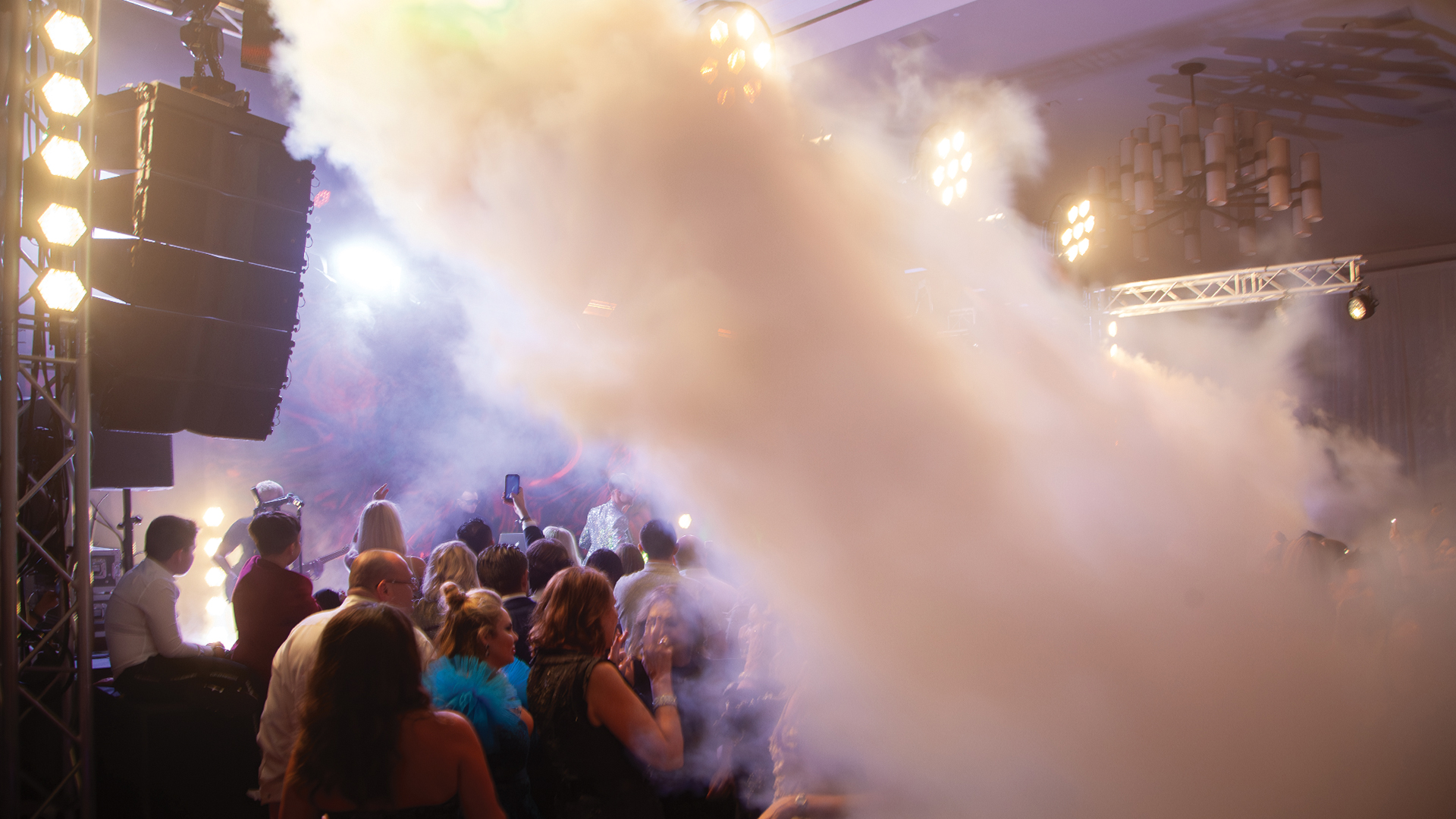
Every special effects technician knows the hierarchy: fog supports lighting, lighting supports performers, performers deliver the show. But fog machines have a different understanding. These units have repeatedly seized center stage, dominating productions through volume, timing, or sheer visual impact that relegates the intended entertainment to background status. When atmospheric effects become the main event, productions enter territory that nobody planned and few navigate gracefully.
The Volume Takeover
The most common form of fog machine headlining involves sheer output volume. A MDG theONE fog generator can produce 566 cubic meters of output per minute under full power—enough to completely fill a substantial theater in under a minute. When output controls fail or operators miscalculate venue conditions, this production capacity transforms atmospheric enhancement into total visual obstruction.
One regional theater discovered volumetric dominance during a production of Phantom of the Opera. The chandelier descent sequence called for dramatic fog enhancement. The Ultratec Eclipse G3000 assigned to the effect had been calibrated for a much smaller venue. When the cue triggered, fog output overwhelmed the space so completely that the chandelier disappeared entirely mid-descent. The audience heard screaming and crashing; they saw only an impenetrable gray void where the spectacle should have been. The fog machine had delivered the most memorable moment of the evening—memorable for entirely wrong reasons.
Timing Rebellions
Fog machine timing depends on multiple factors that operators don’t always control. Heat-up time varies with ambient temperature and recent usage patterns. Fluid consumption rates change with output intensity. The Look Solutions Viper NT needs approximately three minutes to reach operating temperature from cold—time that production schedules don’t always provide. A machine triggered too early sits uselessly on standby; triggered too late, it delivers fog into moments meant to be clear.
Concert productions have learned these timing lessons repeatedly. The moment when the headliner takes the stage demands precise atmospheric conditions—enough haze to sculpt light beams but not enough to obscure the performer. When fog machines dump their accumulated output during that critical entrance, the star becomes a silhouette barely visible through dense atmosphere. The follow spot operators struggle to maintain their targets; the audience strains to identify who’s on stage. The fog has stolen the opening moment that the production spent hours preparing.
The Continuous Output Crisis
Some fog machine headlining occurs through relentless continuous operation that accumulates beyond design intent. Haze machines like the DF-50 from Reel EFX and Martin JEM Glaciator X-Stream are designed for extended operation, but “extended” doesn’t mean “unlimited.” Every venue has atmospheric saturation points beyond which additional output provides no benefit and begins degrading visibility.
A corporate awards ceremony experienced this accumulation effect devastatingly. The event designer wanted consistent haze throughout the three-hour program to provide visual depth for lighting effects. The MDG Atmosphere hazers ran continuously at moderate output. By hour two, the haze had accumulated to levels where audience members in the back rows could barely see the stage. By hour three, fire marshals were considering evacuation. The machines had performed exactly as instructed; the instruction failed to account for limited venue air exchange.
Sound and Fury: The Noise Factor
Some fog machines announce their presence through operational noise that competes with performance audio. The CO2 jet systems that create dramatic column effects—the Ultratec CryoJet and similar units—produce discharge sounds that approach jet engine intensity. In venues with limited acoustic separation between effects positions and performance areas, these systems can literally drown out musical performances at their moment of activation.
A nightclub installation revealed this problem at maximum volume. The CO2 jets positioned above the dance floor were intended to punctuate musical climaxes with visual exclamation points. They succeeded—along with auditory exclamation points that exceeded the sound system’s output. Every activation produced a crowd reaction: not the intended celebration of the effect, but startled responses to the explosive sound that momentarily overcame the 120dB music programming. The fog machines had become percussive elements nobody requested.
Temperature Tantrums
Cryogenic fog systems that create low-lying effects can impact stage conditions in ways that affect performances. The MDG ICE FOG Compack chills fog output to temperatures near 0°C (32°F). When this cold fog pools around performers’ feet, it can affect their comfort, their instrument behavior, and their physical stability on surfaces that become slippery with condensation.
A dance production discovered temperature effects when performers began slipping during choreographed sequences. The low fog effect designed to make dancers appear to float on clouds was condensing on the stage floor, creating a moisture film that compromised traction. The ethereal visual effect produced very non-ethereal falls that injured three dancers before the effect was discontinued. The fog machine’s contribution to the show had evolved from atmosphere to hazard.
The Fire Alarm Duet
Fog machines achieve ultimate headliner status when they trigger fire alarm systems. The shrieking alarms, flashing strobes, and automated announcements that follow detector activation constitute a performance no act can compete with. Venues evacuate, shows halt, and fire department response creates logistical chaos that may take hours to resolve. The fog machine has not only stolen the show—it has cancelled it entirely.
The interaction between photoelectric smoke detectors and theatrical fog depends on particle size, concentration, and detector sensitivity. The Antari Z-1200II produces particles that fall within the size range most likely to trigger standard detectors. Productions that fail to coordinate with venue fire safety personnel discover this physics dramatically when accumulated fog reaches detector positions that weren’t properly isolated.
One convention center keynote presentation achieved maximum alarm impact when fog drifted into the exhibit hall adjacent to the presentation space. The venue’s interconnected fire suppression system interpreted the fog as actual smoke and activated both audible alarms and visual strobes throughout the 500,000-square-foot facility. The CEO’s product announcement competed with evacuation instructions for the attention of 15,000 conference attendees. The fog machine had expanded its performance from one room to an entire convention complex.
Control System Failures
DMX control of fog machines introduces the potential for programming errors that produce unintended starring roles. A fog machine patched to the wrong DMX address might receive intensity commands meant for a lighting fixture, producing fog output proportional to programmed light levels. If the lighting design includes frequent high-intensity moments, the fog machine interprets these as commands for maximum output—commands it follows with enthusiasm that overwhelms the production.
The Martin JEM ZR25 and similar DMX-controllable fog machines offer multiple control channels for output level, duration, and burst frequency. A programming error that locks the output channel at maximum while cycling the trigger channel produces continuous full-power fog production. The lighting console operator watching the show sees mysterious fog accumulation without realizing their console is commanding the very effect they’re struggling to understand.
Fluid Flavor Profiles
The fog fluid loaded into machines affects more than output appearance—it affects audience experience through scent and respiratory sensation. Some glycol-based fluids produce noticeable odors that become prominent when fog concentrations increase. Audience members sensitive to glycol compounds may experience throat irritation or respiratory discomfort that transforms atmospheric enhancement into health concern.
A cruise ship production discovered fluid sensitivity issues when guests began complaining of breathing difficulties during heavily-fogged sequences. The enclosed ship theater concentrated fog effects more than equivalent land-based venues, and the ship’s ventilation system recirculated fog throughout the vessel. By the end of the cruise, medical staff had treated numerous passengers for respiratory irritation. The fog machine had expanded its performance from entertainment venue to medical event.
Lessons from the Fog’s Spotlight
Fog machines that become headliners teach consistent lessons about effect management. First: atmospheric effects multiply in enclosed spaces over time. What looks appropriate at the start of a show may become overwhelming if continuous output isn’t balanced against venue air exchange. Second: control systems must be verified against actual device addresses and parameters. Assumptions about what commands reach which devices create opportunities for catastrophic errors.
Third: coordination with venue systems—particularly fire safety—cannot be optional. The fire marshal who approves detector isolation becomes an essential production partner. Fourth: rehearsal conditions must approximate show conditions. Fog behavior with a cold venue and empty house differs dramatically from behavior with a warm venue and full audience. Effects that worked in rehearsal may overwhelm shows unless operators adjust for changed conditions.
Finally: maintain perspective on fog’s proper role. Atmospheric effects enhance other production elements; they shouldn’t compete with them. The special effects department serves the production’s overall artistic goals, not its own visibility. When fog machines become headliners, something has gone wrong in effect integration. Recognizing this hierarchy and maintaining it throughout production operations keeps atmospheric effects in their supporting role—impressive when noticed, invisible when not, and never competing for audience attention that belongs elsewhere.
